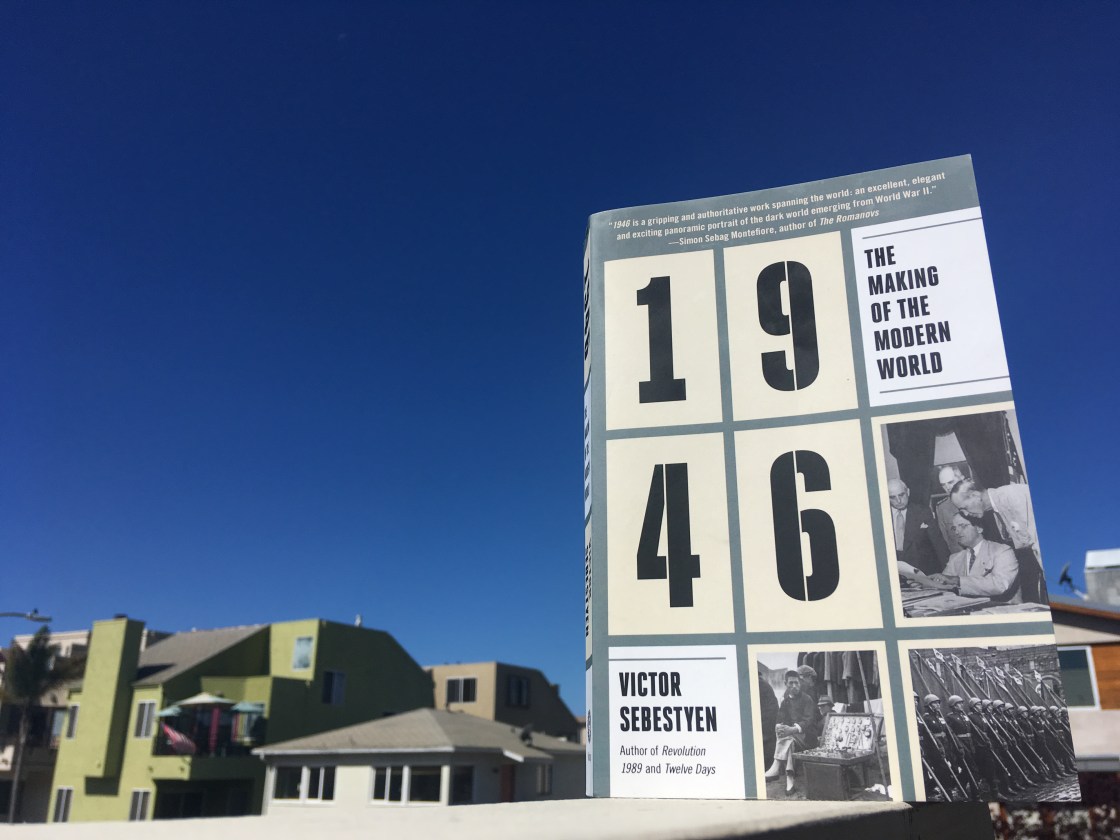
History is made when great events occur, but the foundation for these events take place during those less examined periods of transition. Victor Sebestyen’s 1946 examines the year after the Second World War where decisions made by the great powers, United States, Soviet Russia, and Great Britain, laid the groundwork for events, dilemmas, and conflicts for the second half of the 20th century. United States would gain empire; Great Britain would lose theirs. The Cold War between the United States and Soviet Russia would start almost immediately after hostilities with Germany had ended. Twice did these two nations almost start fighting over events in Iran and Turkey. Germany and Japan both had to face the ire of rebuilding from the destruction of the war. The largest refugee crisis to ever have existed plagued Europe for many years. In time, Europe would rebound; Germany would return as an industrial powerhouse, Japan would become an economic contender on the world stage, and the Soviet Union, the great menace to the West, would crumble.
American stimulus prompted a rebound of European unity and set the stage for Japanese economic power later in the century. It is obvious that those who received American aid during the post-war years have found great benefit in modern times. While Stalin exercised brutal control over his people, he made many mistakes by failing to stake land in oil-rich Central Asia and overplayed his hand when dealing with client-states. 1946 is a reminder that nations are comprised of people that work out of self-interest. The book points out that had America backed nationalist Vietnamese, despite their label as Communists, the Vietnam War could have been avoided. It’s a reminder that ideology also drives decision, as well as the belief that one’s beliefs are the best beliefs.
Overall, I found this book quite interesting considering there is so little attention given to periods of transition. For example, the Reconstruction South laid the groundwork for the multitude of cultural and social issues we have today. As with general knowledge of American history, transition periods tend to be glossed over. History of the post-war years returns to focus on America and the industrial boom that took place. 1946 maintains the focus on Europe, Central Asia, and the Pacific. There you see the continued antisemitism (resulting in continued bloodshed), British forfeiture of India, the mishandling of partitioning land for Israel in Palestine, and the low-intensity conflicts that took place in Greece, Hungary, and Eastern Europe.
The chapters jumped around from one geographic location to the next, touching on these different events. What was surprising but not entirely unexpected was the continued slaughter of Jewish people carried out by Poles and Eastern Europeans. The irony being Jewish people found safety in Germany after the war. General MacArthur’s heavy-handed approach to rebuilding the Empire of Japan into a modern democratic state was also interesting. He essentially told the Japanese to break the feudal system and the large, state-run companies… or else.
Overall, it was an interesting reminder of how past atrocities can be overlooked for the pragmatism of the present. In Germany, so many scientists and engineers, who had committed war crimes and were members of the Nazi party, were sent over to the United States to aid in building new atomic technology. After the war, there were many civil servants affiliated with the Nazi party that the Allied powers realized they couldn’t dismiss everyone otherwise they would lose valuable expertise in keeping the country running and running well.
I enjoyed this book because it illustrates the value of examining those middle periods in history. You understand the foundations for the events that permeated the remainder of the century. I would highly recommend reading 1946 by Victor Sebestyen.
 Mike Maz